

Author: lisanuss
San Francisco school equity fictions are not progressive
- By Lisa Nuss | Special to The Examiner |
- Sep 15, 2022 Updated 22 hrs ago
Please see this Op/Ed I published in the San Francisco Examiner this week. While I figure out how to reprint the piece, please follow link below:
What if we reformed the ACTUAL causes of the Achievement Gap?
There wasn’t room in the OpEd to add that we’ve failed to address the actual causes of the achievement gap. A popular trend in corporate consulting coaches people to reframe challenging problems. If your efforts to change an outcome consistently fail, then maybe you’re not solving the right problem. In this case posed in my OpEd, the “problem” has been that mostly white and/or wealthy kids are tracked into achievement math, while mostly non-wealthy and/or non-white kids are tracked into remedial math. The “solution” that the California and San Francisco public school administrative brain trust invented was to eliminate different math levels. I’m not aware of any measurable improvement to the achievement gap since 2014 when this stupendous plan was put into place. I believe the achievement gap today is worse than it was in 2014, and that’s because we didn’t reform the actual problem.
First, I suggest reframing the “Achievement Gap” by calling it a “failure to teach.” “Achievement gap” seems to put the onus on the kids who don’t achieve; whereas “failure to teach” puts the onus on schools that don’t educate. When we shift our minds this way, it allows us to wonder: What if the failure is inherent in the school system and not in the non-wealthy, non-white children (or their families)?
We have data showing low student performance by race and class in the U.S. are directly connected to the following factors:
poor teacher quality
arrogance of middle class educators and volunteers
teacher/administrator bias
lack of resources
Any new “equity” program that doesn’t reform those problems can’t succeed. But here we find the conflict of interest. The players involved in factors one through three above are the ones who get to frame the problem. But here, you, the reader, and I get to frame. As my law school Contracts Professor would say, “Reason with me….”
Have we correctly identified the problem?
Here’s an example of the achievement gap. Last year at my son’s public middle school in Marin County, California, (Bayside MLK) more than half the kids were failing math class. The teacher ranted daily about this problem to the class, scolding the children for failing to learn. Bayside has a mix of mostly wealthy white students from Sausalito, mostly non-wealthy, non-white kids from Marin City, and a spattering of others. A majority of the students failing were non-white. This is more than a gap — it’s a monstrous chasm of failure.
For decades, the middle class mostly white people who run schools look at these kinds of outcomes and speculate about how non-white families are not supporting their children, are too over-worked or the kids are too undernourished to learn properly. Recently a San Francisco School Board member offered that a certain swath of non-white children weren’t doing well because their parents were lazy.
But let’s take another look at the “problem” by adding in some facts. Most of the wealthy white students who passed had private tutors. Most of the students who failed did not have private tutors. One might reframe the problem this way: If the only students who did well in math had private tutors, the problem looks like the school is failing to teach. Instead of going down another rabbit hole of speculating about what’s “wrong” with the failing kids’ families, let’s take a look at what’s wrong with administrators who are paid over $200,000K and send more than half their 8th graders into high school having failed to teach them math? That’s a discussion I would love others to join me in. Thanks to some of my work, one of those $200,000K administrators will shortly be leaving the area – but others lurk above him that are paid more.
John Taylor Gatto, the three-time New York State Teacher of the Year who quit public teaching said he did it in large part due to the administrators who rise through today’s public schools system. Thirty years ago he predicted the “disaster of ignorance” plaguing our public schools:

“If we’re going to change what’s rapidly becoming a disaster of ignorance, we need to realize that the institution “schools” very well, but it does not “educate”
Gatto in Dumbing us Down (1991)
It took me years of research, combined with my own parenting and years of homeschooling my son, to finally “get” that children are natural learners. If students aren’t learning, the adults in the room have gotten in their way or done something wrong.
I’ve watched the California public schools fail to teach math due to poor teacher/administrator quality — I’ll provide details in a later post, with citations from experts noting that no reform can succeed without improving teacher quality.
The arrogance in “solving” the achievement gap to me is revealed in the fact that it’s called an achievement gap. Many of the suburban middle class and mostly white public school teachers/administrators at my son’s schools have always had a whiff of condescension against kids and families who are non-wealthy and/or non-white. Not all of them to be sure. But enough. And this also goes for the wealthy white mom volunteers as well.
I got my first whiff of this when my son was in First Grade. His First Grade was the first year of Common Core… fun times. One of the mom groups at the school decided they would fix the reading problems some lower income children had by giving them books to keep in their homes. Because data had shown a connection between books in the home and literacy, it was presumed that the existence of the one directly lead to the other.
My son’s best friend was from a family we’d say was from the “wrong side of the tracks.” Lots of kids, wearing mis-matched clothes, both parents dropped out of high school. They had a lot of interests, and the kids were smart, curious, energetic and resourceful — but they were not a family of readers. Anyway, their house was a disaster — which is not a judgment because mine is often as well — it’s just a fact. The kids lost school library books they checked out, so they lost their borrowing privileges. The school thought if they gave them their own (used) books to keep – that would solve the problem. Despite their best efforts, turns out books got lost in that house, library or not. They were not a family of readers and school was not going to make them into a family of readers.
Readers informed about literacy challenges can probably guess what the real problem was. The surface problem was several of the kids weren’t doing well on tests — but the cause was not lack of books in the home. The cause in one case was dyslexia, in another was an undiagnosed learning disorder and in another was anxiety.
Thinking that those problems will be solved with a home library is almost laughable – especially when the very highly paid principal was a special education expert. This was 2014 and the school had no idea how to handle dyslexia. With 30 kids in one class, and a new Common Core curriculum driving the teachers crazy, their only “solution” for kids with trouble reading was to have them stay after school for more reading.
A fellow parent whose a college math professor heard me tell this story and he said, “Great solution! Let’s do MORE of what’s not working.” He eventually homeschooled his kids in the same program as mine.
The other child with an undiagnosed learning disorder was just sort of passed through as was the one with anxiety. Classrooms full of 30 kids don’t allow even the best trained teachers to give children the attention they need. So lack of resources is a huge part of it, but there was a punitive attitude to the kids who couldn’t keep up.
Learning challenges can be hereditary, which in this case partly explains the parents having dropped out of high school, which partly explains their financial challenges. The pattern leads middle class educators to treat them like they’re not smart, or lazy. The family didn’t need to be “fixed” — the school system needed to be fixed, with funding to have small class sizes, and quality curriculum to address learning challenges, and quality teachers to guide students in their learning.
Now in Marin there’s a volunteer group trying to close the achievement gap. This group’s existence is pointed to often as some kind of sign that progress is being made, and yet the gap in Marin persists as it does around the state. I see reports of lots of things the group says they have accomplished. But more than half the kids in an 8th grade class in the only town in Marin with a significant Black population failed math, so I don’t think the volunteer group has cracked the code.
To be continued…
audit faults educators for achievement gap
By Lisa Nuss
Published March 28, 2015, in the Oregon PEN
Published March 28, 2015, Oregon PEN Issue #6, Salem, Oregon. Oregon Public Empowerment Network (PEN) was a year-long effort to create a socially conscious news outlet, founded by Public Interest Lawyer John Gear. Lisa Nuss served as editor and primary writer.
teachers and administrators issue harsher discipline for students of color
By Lisa Nuss
In 2015, the Oregon Legislature passed a law to limit principals’ use of out-of-school suspensions and expulsions as a discipline for minor problems.
The need for such a law begs the alarming question – have Oregon elementary principals been suspending children out of school for non-violent behavior to such an extreme that a law had to be passed to stop them? The sad answer is, yes, according to the Portland-based Youth, Rights and Justice Project.
In 2015, I interviewed the bill’s sponsor, Mark McKechnie, director of the Youth, Rights and Justice Project. McKechnie’s press release is pasted below. He told me that in the 2013-14 school year, nearly 8,000 students in Oregon grade schools (we’re talking ages 5-11) were suspended or expelled, and 71% of these actions were in response to “disruptive behavior” that never presented actual harm to anyone.
McKechnie’s data shows that 5,000 of those 8,000 extreme punishments will be prevented under this law. That’s an astonishing 5,000 children who were forced out of their schools by their principals for labeled “disruptive behaviors.” And sadly there are serious racial disparities in the children whom the mostly white, middle class “educators” label “disruptive.”
In the press release below, he finds that the discipline inequities are most acute for African-American and Native American students in grades K-5. (See charts on the right.)
Oregon Legislature Gives Final Approval to Elementary School Discipline Reform Bill
For Immediate Release, 5/21/15
Contact: Mark McKechnie, Executive Director, Youth, Rights & Justice
Mark.M@youthrightsjustice.org or 971-506-4112
Salem, OR–The Oregon House of Representatives voted to pass SB 553-A on a bipartisan vote of 41-18 today. The bill, introduced by chief sponsor Sen. Sara Gelser, previously passed the Oregon Senate 27-3 and will head now to the Governor for her signature.
SB 553-A limits the circumstances when students in grades K-5 can be expelled or suspended out of school. In the 2013-14 school year, nearly 8,000 students in elementary grades were excluded from school due to suspension or expulsion. Seventy-one percent of these actions were in response to “disruptive behavior.”
SB 553 has the potential to prevent suspensions and expulsions for more than 5,000 elementary school students in Oregon each year. The bill limits the circumstances when the youngest public school students can be excluded to incidents when a student causes serious physical injury to another student or staff member, when the student’s behavior poses a direct threat to health or safety or when required by federal law. The bill does not restrict the use of in-school suspension or other forms of discipline.
SB 553 was drafted by Youth, Rights & Justice, a Portland-based non-profit organization which represents children and youth in the juvenile court and education systems. Suspension and expulsion disproportionately impact students of color, low-income students, students with disabilities and children in foster care. African-American students are suspended at roughly three times the rate of white students in Oregon, a problem that starts in kindergarten. Supporters include the Oregon Alliance for Education Equity, Stand for Children, Portland Parent Union, the Northwest Health Foundation, ACLU- Oregon, and the City of Portland Office of Equity and Human Rights’ Black Male Achievement Committee.
Youth, Rights & Justice executive director, Mark McKechnie, said, “We applaud the strong bipartisan support of the Oregon Legislature in passing SB 553 this session. Legislators from around the state recognize that suspension and expulsion have been overused in a way that is harmful to Oregon’s students, families, schools and communities.”
Testimony from BLACK MALE ACHIEVEMENT PORTLAND
May 6, 2015
Representative Margaret Doherty, Chair House Education Committee 900 Court St. NE, Hearing Room D Salem, OR 97301
Re: Support for SB 553
Dear Chair Doherty and Members of the Committee:
Black Male Achievement Portland is concerned about the disparity in discipline, specifically suspension and expulsion, in Oregon’s school systems. To say that there is a crisis in the educational outcomes for our youth of color, and specifically our Black youth, is in no way hyperbole. This is our next generation of leaders and the data are clear. Children of color are disproportionately disciplined, suspended and expelled, with Black boys the most impacted by exclusionary discipline.
Black Male Achievement Portland (BMA) is a collaborative under the auspices of the National League of Cities, led by a Steering Committee of Black men who represent over 20 organizations, non – profit, for profit, or governmental agencies. It focuses on the removal of barriers to accessing high quality and equitable employment, education, public safety, and livable communities on behalf of Black men and boys. BMA acts as a convener, facilitator, policy guide, and collective voice to obtain data, push for policy change, increase program scale, and exert influence to create awareness and change to improve outcomes for Black men and boys.
The idea of exclusionary discipline beginning as early as kindergarten goes against the fact that early instruction is critical to creating the love for learning that we hope to instill in our children, and the opportunities for success that the system is obligated to provide. In Oregon, Black youth are three times more likely than their white counterparts to be suspended or expelled. If, as we know, third grade reading ability is critical to continued success, such exclusionary discipline serves to undermine our efforts achieve that success. Further, research shows that exclusionary discipline significantly in creases the likelihood that a student will become 2 engaged in the juvenile justice system. We know that the “school to prison pipeline” is all too real. If exclusionary discipline can be attributed to the beginning of that pipeline, we have an obligation to use it sparingly, and with significant oversight.
For these reasons, BMA Portland supports any effort to minimize exclusionary discipline and asks this committee to thoughtfully consider and support Senate Bill 553.
Thank you for your consideration. If you have any questions, please do not hesitate to contact the BMA through Dante J. James at dante.james@portlandoregon.gov, or at 503 – 823 – 4433.
Audit finds OR schools need to improve teacher training and use of mentoring
By Lisa Nuss
Published March 13, 2015, in the Oregon PEN.
Published March 13, 2015, Oregon PEN Issue #4, Salem, Oregon. Oregon Public Empowerment Network (PEN) was a year-long effort to create a socially conscious news outlet, founded by Public Interest Lawyer John Gear. Lisa Nuss served as editor and primary writer.
Oregon Schools failing minority teacher hiring goals
An article Lisa Nuss wrote on February 28, 2015, for the Oregon PEN:
Published Feb. 28, 2015, Oregon PEN Issue #3, Salem, Oregon. Oregon Public Empowerment Network (PEN) was a year-long effort to create a socially conscious news outlet, founded by Public Interest Lawyer John Gear. Lisa Nuss served as editor and primary writer.
K-4 Curriculum Guides
By Lisa Nuss
I was hired to write a series of curriculum guides for an online publishing company circa 2012. From a library of a local teaching college, I studied best practices along with new scientific understandings of how we learn. I have detailed guides for 1st through 4th grades, with overviews on creating curriculum, and then specific details on math, reading, writing, social studies, science, art, drama and music. Please contact me for ordering information from the backlog.
For a sample, this is a reprint of my Guide to 2nd Grade Curriculum (please don’t reuse without permission):
Lesson 2 – Creating Curriculum
- Learner-Centered Concept to Designing Curriculum
One of the major developments in curriculum over the last several decades has been a shift to presenting material in a format that is “learner-centered.” Making the shift to this style of teaching is more an attitude than a technique, according to the authors of Learner Centered Teaching[1].
The goal is to cultivate an environment that encourages learning, in contradiction to the old model of the strict teacher in the front of the room lecturing while students sit quietly and listen. To some, this new approach appears “touchy feely” and many may think students need a “firm hand;” but as mentioned in Lesson 1, recent scientific studies back up these methods to learning.
Five features that comprise a learner-centered approach are:
- Respect for students – Approaching students with respect can create a positive feedback loop. Students who are treated with respect will value themselves and can, in turn, value and respect the teacher.
- Acceptance of students – Accepting students and their ideas allows them the confidence to continue to grow and change; in contrast, a student who fears judgment will close down and become defensive.
- Effective communication in the classroom – This includes two-way communication: the students need to understand the teacher, but also the teacher needs to understand the students.
- The needs, problems and feelings of students are valued – We now know that the so-called “rational,” intellectual, learning self cannot be separated from the emotional self. Second graders have a lot of feelings and experiences to make sense of, and these will impact and direct their learning abilities.
- Permissiveness – In this context, permissiveness does not mean “touch feely” – it means giving students freedom to have their own ideas and beliefs.
The whole concept of learner-centered teaching upends our old ideas of the proper authority of a teacher. This teaching approach exercises authority in a different way. When teachers wield authority in a way that shows intolerance for others, it merely teaches students to also be intolerant. When authority is wielded by an emotionally secure teacher who doesn’t need to defend all of her own beliefs, then the student is freed to flourish in a safe environment.
- Presenting Curriculum That Engages Students
Presenting curriculum content in an environment where students feel comfortable expressing their ideas and are not embarrassed by their mistakes has repeatedly been shown to increase overall student performance.
In Best Practice: Today’s Standards for Teaching and Learning in America’s Schools, the authors note that studies have shown students taught with a more engaging, interactive curriculum approach have posted significantly higher scores on the Iowa Test of Basic Skills and other reading achievement tests. The method of teaching is as important as the curriculum content, in affecting what students learn.
But how to engage students is a challenging question. The Best Practice book authors culled recommendations from various disciplines, and found an “unrecognized consensus” in how to shift towards this new model. They provide a guide of what to do more and what to do less – some of those concepts are excerpted in the chart below:
LESS IS MORE
Common Recommendations of National Curriculum Reports
| LESS | MORE |
| Lecturing | Experiential, hands-on learning |
| Student passivity | Active learning with students talking and collaborating |
| One-way transmission of information | Diverse roles for teachers in addition to lecturers: coaches, demonstration, modeling |
| Rewarding silence in the classroom | More attention to a variety of learning styles |
| Class time spent on fill-in the blank worksheets | More emphasis on high-order thinking and a field’s concepts |
| Rote memorization
|
Adapted from: Best Practice: Today’s Standards for Teaching and Learning in America’s Schools, 3rd Ed
The author of Primary Understanding: Education in Early Childhood, Kieran Egan, suggests one place to start is to rethink our perception of young children. Instead of thinking of them as blank slates, value their inherent abilities and experiences thus far. Envision your role as teacher is to overlay a structure on their already full and lively minds:
- Children aren’t blank slates – Egan argues for an approach that combines two things: (1) developing a child’s innate abilities and awarenesses, with (2) teaching the child the formal disciplines of knowledge and thinking in our culture.
- Engage children’s imaginations – In the shift from passive to active instruction, well-meaning teachers may want to engage their students but not know how. One simple technique, Egan suggests, is not to give students mind-numbingly boring assignments; value and engage children’s rich imaginations.
Egan suggests a rule of thumb is: if it’s uninteresting to an adult, it will likely be uninteresting to a child. So many early learning materials and textbooks extract content completely out of context, and transform it into boring, meaningless exercises. This type of teaching is not only boring, but educators believe it can have serious negative consequences; it can undermine student learning and risks permanently turning them off from school.
- Don’t underestimate students – We often appraise intelligence by accumulated knowledge, which perpetually puts younger people at a disadvantage. Egan stresses that while young children may know less than most adults, they are no less intelligent.
Two common mistakes made when presenting curriculum are to: (1) Begin teacher planning with what students need to know in the end and simply work backwards, or (2) Take pieces of content and simplify them. Egan believes the fix is to concentrate on meaning when planning curriculum. It’s difficult for learners to grasp something’s importance if it’s taught out of context, without showing its impact in the real world.
- Infuse curriculum with rich content – Egan explains that we often simplify for children because we believe they don’t know the topic. While it’s true young children may not know the specific facts of a topic, they do know and can relate to the higher level concepts of a lesson.
The great stories of western civilization are full of dramatic conquests and losses – students can relate to stories that explore fear and relief, courage and cowardice, good and bad. Egan writes that the portal into effective teaching is precisely to tap into children’s own dramatic thoughts, hopes and fears – they can relate to those feelings, and build on their knowledge.
- Move away from the trivial – Many learning activities for children are trivial and sentimental. They are missing the powerful emotional and intellectual content that exists in the real world – and in children’s lives. Many of us recall certain favorite teachers; they are likely the ones who found ways to bring these dramatic and resonating qualities into their classroom.
- Multiple Intelligences & Learning Styles
Diversity is the new norm. Few classrooms in the U.S. lack students from different ethnic backgrounds. Some might still be clustered by common economic backgrounds, but within those classrooms, there will still be diversity in learning styles and abilities.
Part of the acceptance of multiple learning abilities and styles is the realization that there is no one “right” learning style. The old model was focused on teaching to the average student. The goal is no longer to teach to the average student. Some call this curriculum approach “differentiation,” and it’s a key concept to achieve engaging, authentic teaching.
The concepts of learner-centered teaching — respecting a student’s background and current level of abilities — moves the curriculum away from one dominant but narrow focus and broadens teaching. The dominant but narrow focus is no longer “normal” – in fact, there is no “normal.”
The old concept of “intelligence” of the book-smart, analytical, test-taking variety hit a peak in the 1970s with the fad of IQ testing. Educators have since realized IQ tests and many standardized tests measured only narrow abilities of memory recall and abstract reasoning.
The psychologist Howard Gardner believed we measured intelligence too narrowly. Rather than a focus on abilities within the isolated, testing environment – he thought human intelligence should be measured more broadly, to include:
(1) Ability to solve problems
(2) Ability to generate new problems to solve
(3) Ability to make something or offer a valued service
Gardner proposed seven different dimensions to intelligence:
| Dimension of Intelligence | How They Learn |
| verbal/linguistic
|
in words |
| logical/mathematical
|
by reasoning |
| visual/spatial
|
images and pictures |
| body/kinesthetic | somatic sensations –
dancing, running, touching
|
| musical/rhythmic | recognizes rhythms and melodies; listening
|
| interpersonal | bouncing ideas off other people
|
| Intrapersonal | deeply inside of selves; thinking about thinking
|
Scientists believe students possess each dimension to varying degrees, and that the dimensions can be developed. Abilities will vary according to: (1) biological factors – (genetic traits and any physical limitations), (2) personal life history (types of intelligences exposed to), and (3) cultural and historical background.
Researchers have proposed several additional dimensions to intelligence, including: emotional, spiritual, moral, and creativity, among others.
What are the implications for a teacher? The author of Multiple Intelligences in the Classroom writes that children will show proclivities at an early age. By the time they start school, they will have developed some more than others. Most students have strengths in several areas.
Clearly, most teaching in the U.S. has been targeted to the verbal/linguistic dimension, and to a lesser extent, the logical/mathematical. One simple approach for teachers in planning lessons is to move away from those two dimensions and pick at least one other dimension to incorporate. Given the hegemony of the other two, any activity that engages the rest of the dimensions would be a start in the right direction.
Make use of resources that provide suggested activities to engage the whole student. In Seven Ways of Teaching: The Artistry of Teaching with Multiple Intelligences, David Lazear, presents many practical activities for use in the classroom. Just this book alone (or another like it) can provide activities to engage all seven intelligences throughout a school term or year.
- Lesson Planning
In Teaching Strategies: A Guide to Effective Instruction, the authors urge teachers to think of planning as an aid to organize their curriculum and delivery. They emphasize there is no one best way to plan. Some teachers engage in highly structured planning, while other work from more general notes; most fall somewhere in-between.
Ideally, you should develop a plan that helps you meet your curriculum goals but also allows flexibility. However you plan, you should identify the content of your lessons and the methods for presenting that content. The Teaching Strategies[2] text identifies six factors that should be included in your lesson plans:
(1) Student considerations
- Content and process Considerations
- Time considerations
- School considerations
- Resources
- Teacher considerations
The authors suggest you start with any curriculum guides available from your school. They will help build your framework, and allow you to see what the students were taught in the year prior to your class level. Then look to textbooks or other materials available. Finally, glean additional ideas from many sources including colleagues, retail stores, the Internet, local libraries, museums, and government agencies.
Planning should include long-range and short-range goals. The Teaching Strategies text breaks lesson planning down into three cycles — from long-range, to individual lessons and units, and finally to evaluation:
| Stage 1 – Long-range Goals | Stage 2 – Unit & Lesson Planning | Stage 3 – Post-Lesson |
| Standards/Goals | Unit subject | Unit and lesson evaluation |
| Long-range plans for year | Concepts | Reflections and notes |
| Content | Questions and generalizations | |
| Processes | Unit rationale | |
| Student skills and readiness levels | Goals and objectives | |
| Learning activities | Resources and materials | |
| Learning activities | ||
| Assessment tools | ||
| Lesson planning (for each piece of the unit) |
BIBLIOGRAPHY
Richard Arends & Ann Kilcher, Teaching for Student Learning: Becoming an Accomplished Teacher (2010: Routledge)
Thomas Armstrong, Multiple Intelligences in the Classroom (Assoc. for Supervision and Curriculum Development, Alexandria, VA: 1994)
Kieran Egan, Primary Understanding: Education in Early Childhood
Routledge: New York, London, 1988)
David Lazear, Seven Ways of Teaching: The Artistry of Teaching with Multiple Intelligences (Skylight Publishing: Palatine, Illinois: 1991)
Donald Orlich, et al., Teaching Strategies: A Guide to Effective Instruction, 7th Ed. (Houghton Mifflin: 2004)
Gerald Pine & Angelo Boy, Learner Centered Teaching: A Humanistic View
(Love Publishing Co., Denver, CO: 1977)
Steven Zemelman, et al., Best Practice: Today’s Standards for Teaching and Learning in America’s Schools, 3rd Ed., (Heinemann: 2005)
[1] Gerald Pine & Angelo Boy, Learner Centered Teaching: A Humanistic View
(Love Publishing Co., Denver, CO: 1977).
[2] Donald Orlich, et al., Teaching Strategies: A Guide to Effective Instruction, 7th Ed. (Houghton Mifflin: 2004), p. 120.
Primary Schools Withhold Recess – Experts Say Unhealthy for Kids
By Lisa Nuss (originally published in the OregonPEN, Aug. 02, 2015)
Salem-Keizer School District elementary teachers regularly withhold recess as punishment – sometimes only for the offender; sometimes for the whole class.
When the American Academy of Pediatrics stresses the vital role of recess – why are our teachers taking it away?
Recess is crucial to a child’s development
A recent report in Pediatrics, the official journal of the Pediatrics Academy, states that “…recess is a crucial and necessary component of a child’s development and, as such, it should not be withheld for punitive or academic reasons.”
Not only is play essential for children’s development and learning, but we know that children need physical activity. A report in the Journal of School Health makes the same finding. In the article titled, “Withholding recess from elementary school students: policies matter,” (J Sch Health. 2013 Aug;83(8):533-41. doi: 10.1111/josh.12062) the authors emphasize:
“Recess is a key aspect of a healthy elementary school environment and helps to keep students physically active during the school day. Although national organizations recommend that students not be withheld from recess, this practice occurs in schools.”
Schools can’t withhold recess and claim to promote healthy children
Oregon PEN will work on ascertaining how widespread this punishment is in Oregon schools. This practice of withholding recess is especially concerning when our state, along with many others, professes a goal to encourage healthy children.
A website maintained by the Oregon Public Health Division outlines a “Healthy Kids Learn Better” partnership among three state agencies. The website says they are adopting “A Coordinated School Health Approach.” And its vision is “All youth in Oregon are healthy and successful learners who contribute positively to their communities.”
The website further states:
“Healthy Kids Learn Better is a partnership led by specialists from the Oregon Department of Education and the Oregon Department of Human Services – Health Services, in collaboration with other health and education organizations. Together we are reducing barriers to learning in many ways, including:
- ….
- Providing assistance on building and selecting comprehensive health, physical education and counseling programs that work.
Many of the concerns listed on the website as barriers to health are attributed to the child’s families, yet unhealthy practices in our own schools don’t appear on the agenda.
Other states ban withholding recess as punishment
Other states have made this connection. In fact, the National Association of School Boards has explicitly made this connection. It maintains a “State School Health Policy Database” at http://www.nasbe.org/healthy_schools/hs/bytopics.php?topicid=3120
The database lists policies on physical activity and recess when measuring the health of children at school. Michigan, for example, adopts this model policy: “[P]hysical activity, including recess, may not be denied or used for disciplinary reasons.”
Oregon is listed as having no policy.
In its article, the Pediatrics academy stressed that formal, organized PE is different from the vital role in child development provided by free-play recess. And yet, at Morningside Public Grade School in Salem, recess is regularly withheld from Kindergarteners, First and Second Graders. In Kindergarten, sometimes it is the offending child alone who is banned from recess; sometimes if one five year-old doesn’t finish the assignment, recess is withheld from the entire Kindergarten class.
My five year-old came home from Kindergarten about once a week, saying “We didn’t get recess again because Austin didn’t finish his work.” His teacher had told the class that unless everyone finished the assignment, no one could go to recess. Austin had obvious learning problems which, by the way, were not solved by shaming Austin or by punishing the rest of the class.
When I asked the principal of the school, Bonnie Dietrich, whether she approved of teachers withholding recess from the whole class if one child didn’t finish their work, Ms. Dietrich said she had no way of knowing what went on in her classrooms, and “It isn’t my job to supervise the teachers.” As she dismissed me, she added, “It doesn’t matter anyway if recess was withheld because the Kindergarteners have PE once a week.”
If an Oregon elementary principal seems not to be aware of these basic needs of children – what can be done about it?? I called the Salem-Keizer School District next. This principal’s supervisor at the Salem-Keizer School District, Meera Kreitzer, who worked under then-Asst. Superintendent Salam Noor, assured me that the principal, Ms. Dietrich, is “One of our most outstanding principals.” Ms. Kreitzer assured me that I was just a new parent. “You remind me of myself,” Kreitzer said, “when I was a new parent and didn’t understand how schools worked.”
So if one of the most outstanding Salem-Keizer School District elementary principals doesn’t understand the essential importance of free play recess to a child, and neither apparently do Salem-Keizer District Officials, what is a parent to do?
When I called the Oregon Department of Education in the Spring of 2014 to inquire whether the State of Oregon approves of public schools withholding recess from children – either from those who don’t finish their assignments, or from the rest of the class when one misbehaves, the State Department of Ed said local control leaves the policy in the hands of the school district.
An elementary teacher at Auburn Elementary told me that in Oregon, public school teachers are free to use recess as a discipline tool and to withhold it from children when they want to.
The Pediatrics article stressed: “Just as physical education and physical fitness have well-recognized benefits for personal and academic performance, recess offers its own, unique benefits:
- Recess represents an essential, planned respite from rigorous cognitive tasks.
- It affords a time to rest, play, imagine, think, move, and socialize.
- After recess, for children or after a corresponding break time for adolescents, students are more attentive and better able to perform cognitively.
- In addition, recess helps young children to develop social skills that are otherwise not acquired in the more structured classroom environment.”
All of these points pinged in my head as I listened to my son’s highly-paid principal tell me she sees no difference between structured PE and recess and has no concern with recess being taken away from five year-olds.
The Pediatrics article goes on to say,
“In this sense, then, pediatricians’ support of recess is an extension of the American Association of Pediatricians’ policy statement supporting free play as a fundamental component of a child’s normal growth and development.”
Excerpts from the article in Pediatrics appear below. Parents and school boards are encouraged to compare these recommendations against the practices in Oregon schools, and start asking their districts to justify denying a young child’s essential need for free play.
Banning recess symptom of mismanaged schools and lack of funding
At my son’s school (Morningside Elementary in Salem), this last year, recess was withheld daily from children in First and Second Grade. In his First Grade class, Mrs. Baez withheld recess for children who did their art “wrong” and who didn’t understand their assignments or couldn’t finish them before lunchtime. Given that the new rigid Common Core requirements had obviously challenged this experienced teacher’s ability to teach more complicated math, and given that she posted a funding plea on the Internet for more computer tablets since many of her First Graders that came out of Morningside’s Kindergarten were reading at pre-school levels, then it seems that the problem was that Mrs. Baez needed support in her class — the problem was not six year-olds who needed to be punished from recess. If an otherwise dedicated teacher thinks her only option is to ban kids from playing with each other during their sole 15 minutes of free play and socialization in six hours, then our school district has a serious and systemic problem.
These are six and seven –year-olds who, to a child, will tell you that recess is their favorite part of the day. The children are told not to talk to each other during class, and punished if they talk to each other in the halls or in the lunch line or during lunch. So the only time they have to play or talk with each other is during their 15 minutes of recess, yet Salem-Keizer teachers constantly held the threat of withholding recess over their heads.
During lunch, the children are ordered to stop eating and listen to the long list of kids’ names that are announced who are being punished and can’t go to recess that day. Their names are read out loud to the entire cafeteria of over 100 1st-2nd graders. What a sad and shameful school district these kids attend.
Add this to the fact that on rainy days, the First and Second Graders are given the choice of sitting and watching a movie or sitting and playing board games (they are not allowed to play outside on rainy days because they “are not allowed to get wet”). I went to this exact grade school lo’ many decades ago, and we played outside rain or shine. What’s different now?
So on days when there is no P.E. and it rains, First Graders sit from 9 to 3 with no PE, no recess and no movement other than to get up from their chairs and go sit in other chairs. I took my son out of this unhealthy culture last April, but he worries about his friends whose parents can’t afford private schooling and are stuck there. When he plays this summer with his friends from Morningside, they act out their teachers’ favorite threats: “If you don’t obey me, I will BAN YOU FROM RECESS!”
Recess is a child’s right – it helps their health and helps them learn. Why do Oregonian’s allow their public school teachers to withhold this precious need from our children?
# # #
Lisa Nuss is editor of the OregonPEN. Her opinions have been published in the London Guardian, the Huffington Post, the Philadelphia Inquirer and the San Francisco Chronicle. Her work has been used as curriculum in university courses, and at the Southern Poverty Law Center. She was named the Gerlinger Cup winner at the University of Oregon as an undergrad, and earned a J.D. and M.P.A. from the University of Washington. Contact her at http://author-analyst.weebly.com/
Pediatrics COUNCIL ON SCHOOL HEALTH POLICY STATEMENT:
The Crucial Role of Recess in School
Abstract
Recess is at the heart of a vigorous debate over the role of schools in promoting the optimal development of the whole child. A growing trend toward reallocating time in school to accentuate the more academic subjects has put this important facet of a child’s school day at risk. Recess serves as a necessary break from the rigors of concentrated, academic challenges in the classroom. But equally important is the fact that safe and well-supervised recess offers cognitive, social, emotional, and physical benefits that may not be fully appreciated when a decision is made to diminish it. Recess is unique from, and a complement to, physical education—not a substitute for it. The American Academy of Pediatrics believes that recess is a crucial and necessary component of a child’s development and, as such, it should not be withheld for punitive or academic reasons.
Reprinted from: Pediatrics: The Official Journal of the American Academy of Pediatrics, 2012; 2013;131:183–188.
UPDATE – From Seattle public radio station KUOW, Apr. 21, 2016:
Withholding recess is banned in 10 states. But it’s common in Seattle
https://www.kuow.org/stories/withholding-recess-banned-10-states-its-common-seattle
UO Educ Prof Blasts K-12 Schools for Stifling Students
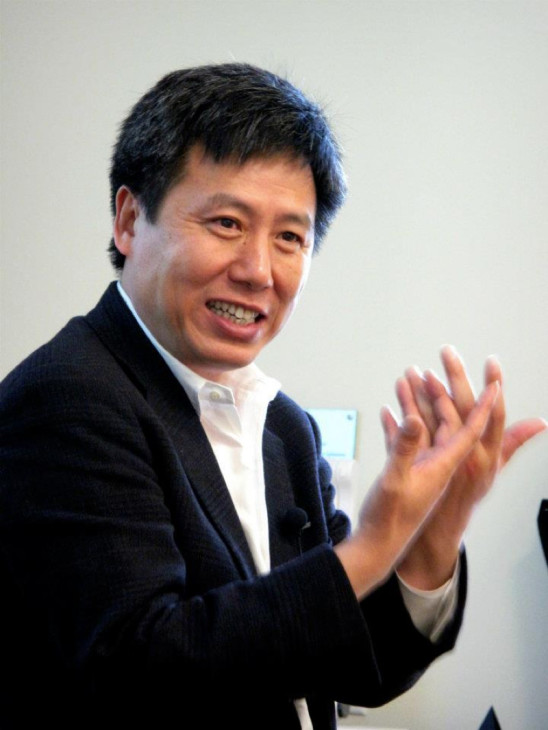
UO Educ Prof Blasts K-12 Schools for Stifling Students:
PSU Speech calls for Enhancing, Not Quashing, Creativity
By Lisa Nuss, published in OregonPEN, 5/16/15
“Every child is Rudolph; our schools are the Bully Coach” — UO Prof. Yong Zhao
Our public schools are quashing creativity and attempting to homogenize children that are born unique individuals, according to University of Oregon Education Professor Yong Zhao. In a speech at Portland state University last month, Zhao warned that as long as we in Oregon and the US ignore what we know about how children actually learn, we are damaging children’s psyches and threatening the economic welfare of our country.
Education Week named Zhao one of the nation’s top 10 most influential university-based education scholars. It is ironic, or perhaps hopeful, that he trains teachers in a state whose public schools are amongst the worst performing and costly in the country. Oregon’s sad state of K-12 can’t be blamed on Zhao, but we can hope that his vision can bring about a needed revolution. (Zhao’s many articles and a Ted Talk can be found on the Internet and readers are encouraged to read his original words.)
Zhao, a critic of the Common Core curriculum that Oregon schools began inflicting on children this year, gave a fast-paced impressive speech that ranged from psychological implications of crushing creativity to economic realities of training a workforce that knows only how to sit still and take directions.
Zhao compared the US’s current approach to compulsory education to the downfall of the once powerful company Nokia. Nokia had once been a leader in cellular technology, and then failed spectacularly by failing to modernize. It clung to a clunky operating system and let past successes blind it to the need to respond to new technology needs. Nokia sank while trying to add smart applications to a limited old system, while Apple went ahead and built a smart phone to support smart applications.
The Misguided Readiness Agenda: “Ready for Something”
Zhao noted that the focus our public schools now take is to say they are making kids “ready for something.” The focus trumpeted in Oregon public schools now is “kinder readiness”; Zhao says the notion of “kinder readiness” is absurd – “kindergarten is not a job” he said.
The “readiness” agenda works like a slick PR campaign – and is equally as devoid of content. Yet Zhao said college “career readiness” is a very seductive notion to parents who want to get their kids ready for life. The problem is that model used to work, but it doesn’t any more.
The “readiness” concept, Zhao continued, presumes the only skills valuable are those that can be measured by written exams. It ignores what we know about individual differences, multiple intelligences, and cultural diversity. The current readiness approach quashes curiosity, passion, and creativity.
Zhao showed a slide much like the one below, which depicts how students come into school with
- individual differences
- multiple intelligences
- cultural diversity
- curiosity, passion, creativity
SLIDE: “Old Paradigm”
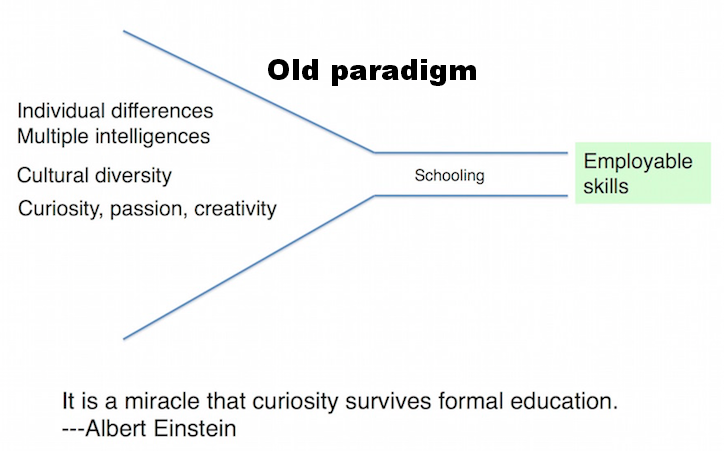
And then the official public school system squashes all of that potential into the funnel of homogenized “Schooling”. The entire goal of the funneling is intended to be “employable skills” which at PSU Zhao added “verified by standardized exams.” Our entire schooling system now is designed to measure – and value — only what can be tested in a one-size-fits-all written exam.
This authoritarian model demands and rewards only one very small, narrow type of intelligence and thinking. Zhao said we should sue all the school boards in the country for discrimination – for allowing a curriculum that explicitly discriminates based on interest and intellectual style.
Treating students like widgets has produced a generation of aimless 20-somethings
Zhao emphasized what many critics have long pointed out: the fact that the current industrial, institutional design of factory-style public education was created to prepare workers for the industrial era.
Zhao spent time in Michigan, where Detroit was once the perfect model of “industrial success.” If you teach children only the rote “basics” of math, reading, how to follow directions, and then they take a job where they show up from 9-5, and are protected by the union, they would have a job for life. That doesn’t work any more.
Computers do routine jobs now, or workers overseas will do them for cheaper. “Readiness” doesn’t work anymore – we shouldn’t focus on “college readiness”
but “out of basement readiness.”
Zhao’s term “out of basement readiness” is a reference to the aimless and jobless early 20-somethings that our current school system has produced. The only thing the current school system prepares children for is to sit and be told what to do, and being punished for any kind of creative thinking or initiative.
Zhao’s goal is to change our school system so that it rewards independent thought instead of quashing it. Zhao imagines a system where our goal is to graduate students that are independent instead of reliant. He believes schools should change so they can prepare students to be:
- Financially Independent
- Socially Independent
- Psychologically Independent
Now, the boomerang generation just produces children that come home after high school and live in their parents’ basement – and they’re loaded down with college debt. The some parents send them to more school – or graduate school – and then they have more debt.
Zhao said this is a problem not only in the US, but also in Australia, Canada, and the EU. High rates of youth unemployment are a serious problem.
We are educating children for a society that no longer exists
Zhao says we are educating children for a society that no longer exists. Schools are still training people to take routine jobs. He referenced the book, “The Second Machine Age” by MIT professors Erik Brynjolfsson Andrew McAfee, which details how we must adapt to the changes that automation has brought to our economy. The authors are digital economy experts.
According to the Washington Post, “The Second Machine Age” argues that our transition to the digital economy “could be made smoother if our education system were reoriented from its industrial-era focus on math and reading to a broader set of personal and intellectual skills necessary for working alongside the smart new machines.”
PBS Newshour interviewed Erik Brynjolfsson and he said: “Historically, education in America has focused on getting people to follow instructions, sitting in rows and listening to what the teacher explains, but going forward we’re going to need much more creativity. Simply following instructions is something that software is pretty good at doing, and that’s not where you want to be competing, but we’re going to have more and more need for creativity.”
Zhao noted that automation is replacing workers in factories, the construction industry, even accountants. He also referenced Thomas Friedman’s book, “The World in Flat” for the prospect that globalization is here – yet our schools are still training people to take routine jobs that can be done for cheaper in other countries.
If a skill can be purchased for less in other country, it will be, Zhao said. This is not only happening to the US – now China is losing jobs to Vietnam, India to Bangladesh.
The question is, what skills cannot be replaced by machines or done with cheaper labor overseas? Those are the skills our schools should be teaching. And while the complaint is always that anything will cost too much money, Zhao emphasized how costly the machine of public schooling in the US has become.
Zhao said the US spends more than $100,000 more to educate children in the K-12 years that China or India. (While he didn’t address funding issues in this speech, OregonPEN will follow-up with reporting on Oregon and US public school funding.)
The reality is the US is losing middle-class jobs and traditional education has failed to move high school and college graduates out of the basement.
Every child is Rudolph; our schools are the Bully Coach
Our schools homogenize children instead of recognizing their individuality. Allowing students to express their creativity and their unique intelligence are the precise skills we will need in the digital economy, yet our public schools are designed to quash this creativity. (Sir Ken Robinson says our schools are “crushing creativity, quite ruthlessly.”)
Zhao noted that while schools tends to homogenize, every child is like Rudolph. At first everyone laughed at him, and no one played with him. Then he was sent to Special Ed, an alternative high school with the misfits — all because he had a red nose!
Then it was not until the foggy night did they need him. Zhao referenced what we know about multiple intelligences and cited more research showing that every child has a unique motivational profile.
We are all born with different propensities, and then nurture plays a role. Malcolm Gladwell publicized the theory that it takes about 10,000 hours to make one an expert. Zhao noted that schools ignore all of this individuality and instead force students to spend 10,000 hours on something average and ill-suited for most. “If you spend 10,000 hours on something you’re not good at or interested in – you get mediocrity.”
Zhao mentioned the great Olympic swimmer Michael Phelps, who has ADHD. Zhao said if Phelps hadn’t had a chance to excel in swimming, he would’ve flunked out of our public schools the way they’re currently structured, and still been working with hooked on phonics.
Stop homogenizing and nurture unique talents and creativity
Traditional education doesn’t value uniqueness; Henry Ford didn’t value “great people” – he wanted a uniform, automated assembly line. Our schools were designed to meet this goal and by continuing to work that way, they take uniqueness and crush it. For most children in schools today, their foggy Christmas never arrived; no one ever realized or appreciated or nurtured their unique talent.
Zhao said the current school model doesn’t work. Schools continue to homogenize when instead they should fix deficits or support strengths. Kinder readiness is wrong-headed because it measures what a five year-old can do only by a pre-cut set of “standards.” The thinking now is that if you can’t read by 3rd grade, you’re done for – but Zhao says, the thinking should be, if you can’t read by 3rd grade, so what? What else are you good at?
Nurturing unique talent is very important. Some professions are not even in existence yet. If you measure kids only by what we know now, you are constricting everyone’s future abilities. We need children who will grow up to invent new ideas. “We talk about ‘think outside box’ – we should get rid of the box.”
Zhao defines creativity as “combining things to come up with something new.” Creativity exists in all of us, yet creativity is not encouraged in schools – “schools don’t like creative people.”
Zhao showed the slide, below, showing the decline in creativity – which drops precipitously at age five – when children enter public school, and is mostly depleted by the time they reach fifth grade. Most children start with what has been rated a “genius” level of creativity, measured by ability to solve problems – yet this ability is destroyed as they go through conventional schooling.
GRAPH: “Decline of Creativity”
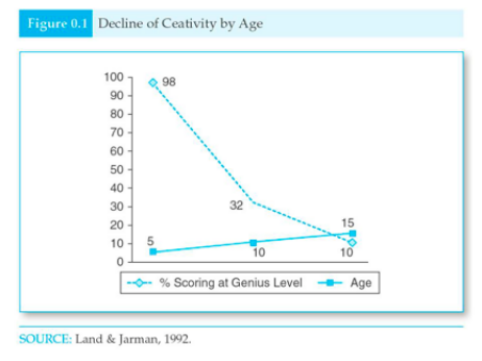
Zhao noted that after schooling has quashed their creativity, many people continue into uncreative lives, and then it’s only in retirement that creativity can bounce back. He commented that even former president George Bush is painting now.
Creativity is not just cognitive, but also psychological and emotional. Zhao says we lose creativity because we learn in our schools to find answers instead of to ask questions.
A study at Berkeley & MIT found that the style of direct instruction used in schools today hinders learning. The study was publicized by Alison Gopnick on Slate.com, in an article titled, “Why preschool shouldn’t be like school” – and Zhao added, “no school should.”
The article’s full title is: “Why Preschool Shouldn’t Be Like School: New research shows that teaching kids more and more, at ever-younger ages, may backfire.” It reviews a fascinating study comparing two groups of kids – those who were shown how to do something and then allowed to explore on their own, were far more interested and engaged than a group who were told by the teacher how to do it “properly”. The ones allowed to discover their own uses played with the items longer, were more curious, and found more functions. Those who were told the proper way to engage with the item did learn the “proper” way faster, so if we’re measuring how fast a child can find the one narrow, expected “correct” answer, then the second group did “better.” But the second group has only learned how to find the one, “right” answer; the first group has learned how to ask questions – they’ve learned problem-solving skills and problem-finding skills.
Zhao says that in addition to enhancing uniqueness and creativity, our schools should be nurturing an entrepreneurial spirit – what Zhao calls a “start-up mentality.” We need children and young adults who think, if they don’t like a policy, they do something about it. And he doesn’t just mean entrepreneur in the business sense, He said we need:
- Business entrepreneurs
- Social entrepreneurs
- Intra entrepreneurs, and
- Policy entrepreneurs
He noted that 14% of Google’s employees don’t have college degrees – these are people innovating today at one of our digital economy’s most successful companies, and they did it without much formal education.
Zhao noted that the US can’t compete with developing countries for cheap labor, and we shouldn’t try. Instead, we have to create more opportunities. We shouldn’t design colleges that allow our young people to compete, but to create.
Don’t educate the average; educate the individual
Zhao said we need to count what counts. It is easy to damage and hard to regain an entrepreneurial quality. We want young people with confidence, friends, passion, creativity, uniqueness and risk-taking.
We need to move the education paradigm, so that we don’t educate the average, but educate the individual
SLIDE: “New paradigm”
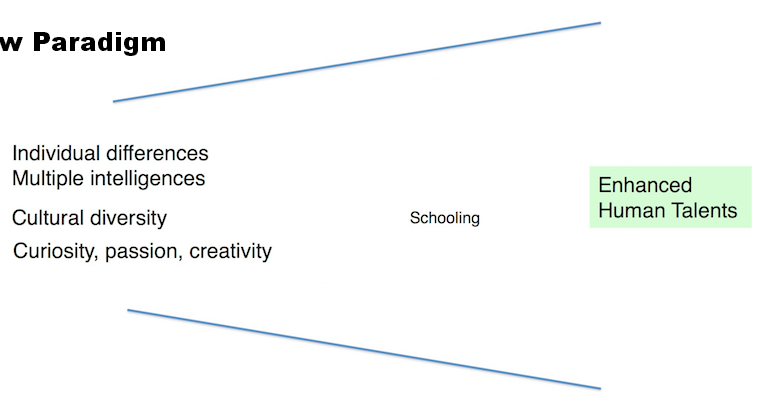
In the new paradigm, schooling takes what we know about learning and instead of quashing, it enhances human talents
Zhao said we have a challenge and an opportunity to get education right. Our current educational reforms – a focus on assessment and testing – are making the same mistake Nokia did; they are trying to perfect the old traditional form, which no longer works. The old platform didn’t work for Nokia and it won’t work for our schools.
Zhao closed with these thoughts – we need to stop trying to fix the past; stop trying to create a one best curriculum for all. We need to follow children’s interests and hire teachers that inspire. He referenced the “Schools in the Cloud” model as proof that children can learn anything.
Graphs reprinted with permission of Yong Zhao
 School Reform 101